Organizations that figure out autonomous AI software development will reshape their industries. The ones that don't will be disrupted by the ones that do. This is how you bring it to your team.
This is the Software Factory. I'm building everything to get you there. 10 years of engineering leadership. Early access.
PROBLEMS
You want AI agents to autonomously build features, but you have no way to trust their output without manually reviewing every line.
AI generates code faster than you can read. One senior can review carefully — but 10 engineers generating AI code all day? 50? Human attention doesn't scale. You need verification that doesn't require reading every line.
It takes a lot of back-and-forth to bend AI to generate the code that will satisfy our organization practices.
Launch your website in no time with our quick publish feature. With just one click, your site will be live and accessible to your audience. No hassle, no delays.
You need to feed the same context over and over to every Agent session.
There is no simple tooling to build agent-based autonomous workflows.
10 years of engineering leadership.
5 years as Head of Engineering at
a fintech,
responsible for building and optimizing the SDLC process.
In my final years there, I led AI adoption into that process.
Now I'm doing the same at
First Connect Insurance Services
Below are the solutions I've built — or teach as supplementary
practices. They address the blockers listed above.

SOLUTIONS
Practice
Solves: AI generated code is not keeping our good practices
You can effortlessly create beautiful and professional websites without any coding knowledge. Choose from a variety of templates and components to design the perfect site for your business.
Practice
Solves: Trust & Human comprehension doesn't scale
Verify behavior, not code. Check AI output matches expectations without reading every line.
Tool
Solves: Lack of Business Context & Context Management
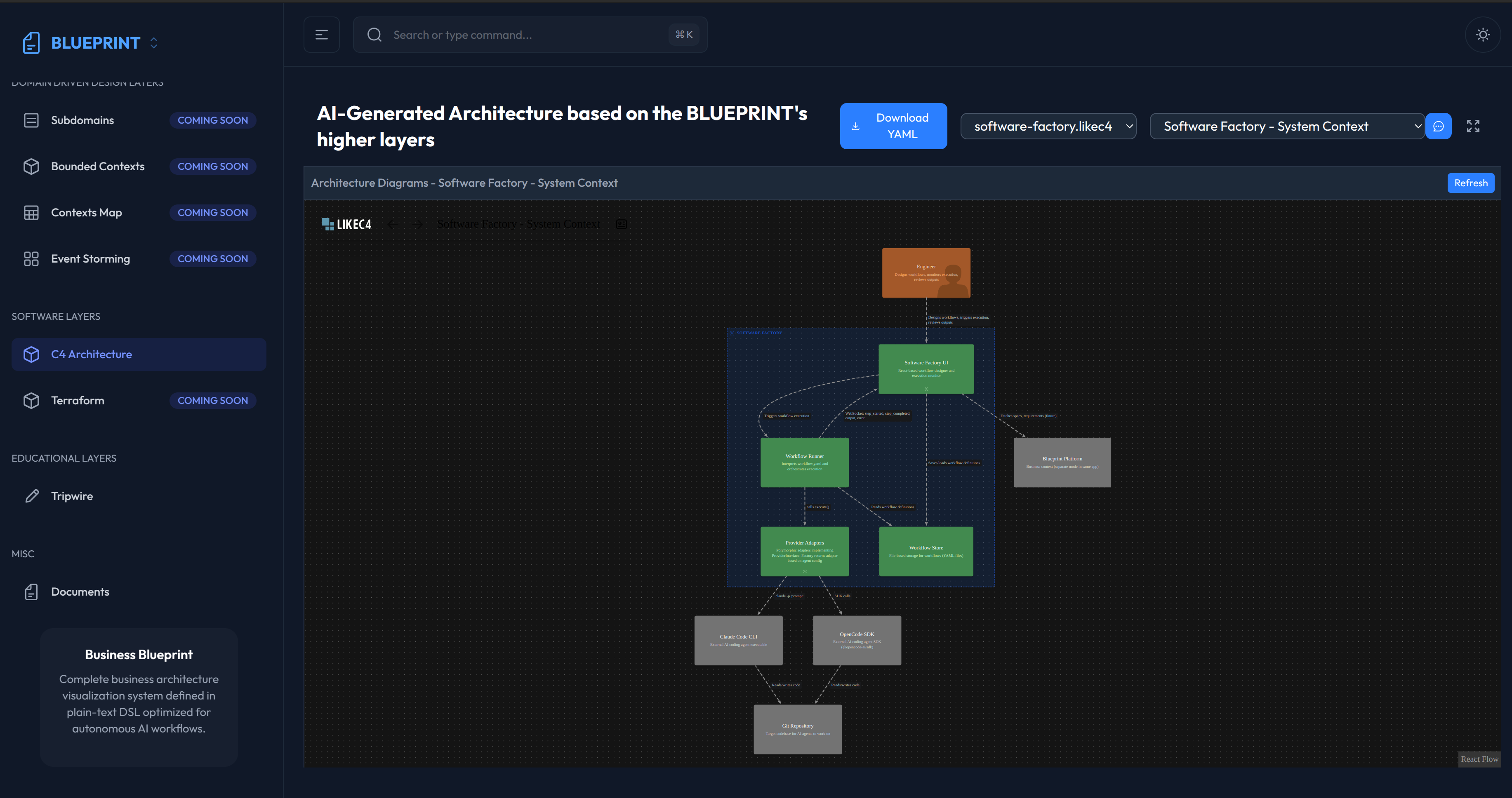
Structured, persistent context AI agents access every session. No more re-explaining your domain.
Practice
Solves: Trust & Context Management
Clear boundaries for AI to work within. Fast tests with mocks matching real adapters. Trust AI changes.
Practice
Solves: Trust
Ship AI changes continuously. Automated testing + feature flags + observability = keep up with AI speed.
Practice
Solves: Business Context & Context Management
Define clear business domain context boundaries. Keep contexts small enough for humans and AI to work effectively.
Tool
Solves: No simple tooling for autonomous workflows
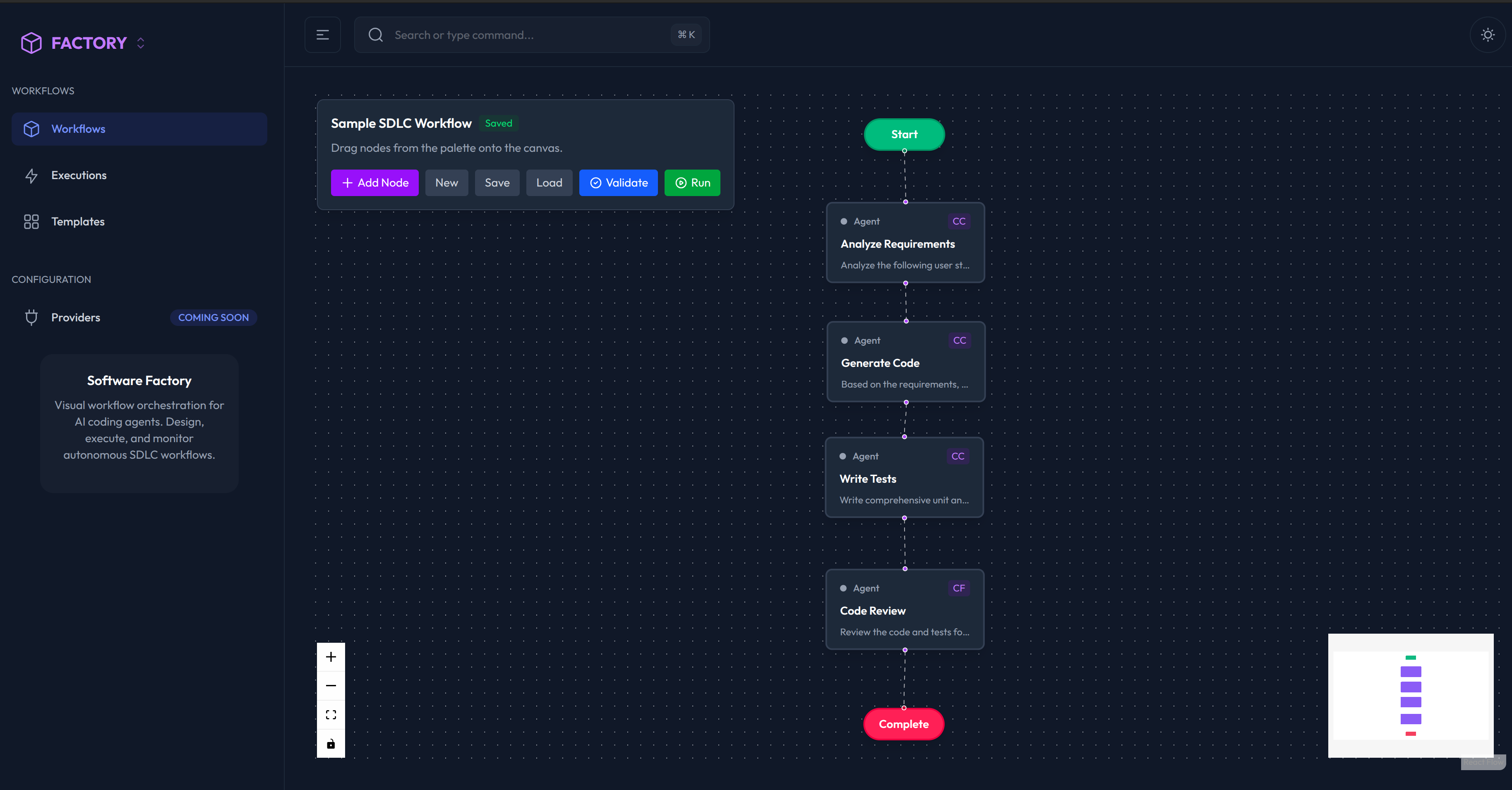
Define your SDLC as a workflow. Engine handles orchestration. Full autonomous pipeline.

✅ TODAY
Learn to write specs that constrain AI and build data-driven BDD tests that verify output automatically.
✅ TODAY
Private community of engineering pioneers figuring out autonomous AI development together.
✅ TODAY
Regular group calls where I answer questions, review your approach, and help you apply these practices to your specific situation.

🔨 IN PROGRESS
A structured context management system for your business, product, and technical knowledge. Give AI agents persistent access to your domain — no more re-explaining every session. See what AI produces — don't just read it.

🔨 IN PROGRESS
A workflow orchestration engine for autonomous SDLC. Define your process as a workflow, let the engine handle execution. From intent to PR, automated. Integrate with GitHub for your developers — or Slack for your Product people (they specify intent, PR lands in your dev queue). Or whatever workflow you imagine.

🔜 PLANNED
Deep-dive courses on Spec Driven Development, Trunk Based Development, Hexagonal Architecture, and DDD — the practices that make AI output match your standards.
📅 ON DEMAND
Live training for your team. Tailored to your stack, your challenges, your pace. Available on request.
📅 ON DEMAND
1-on-1 consulting for complex situations. Architecture reviews, adoption strategy, hands-on implementation help.
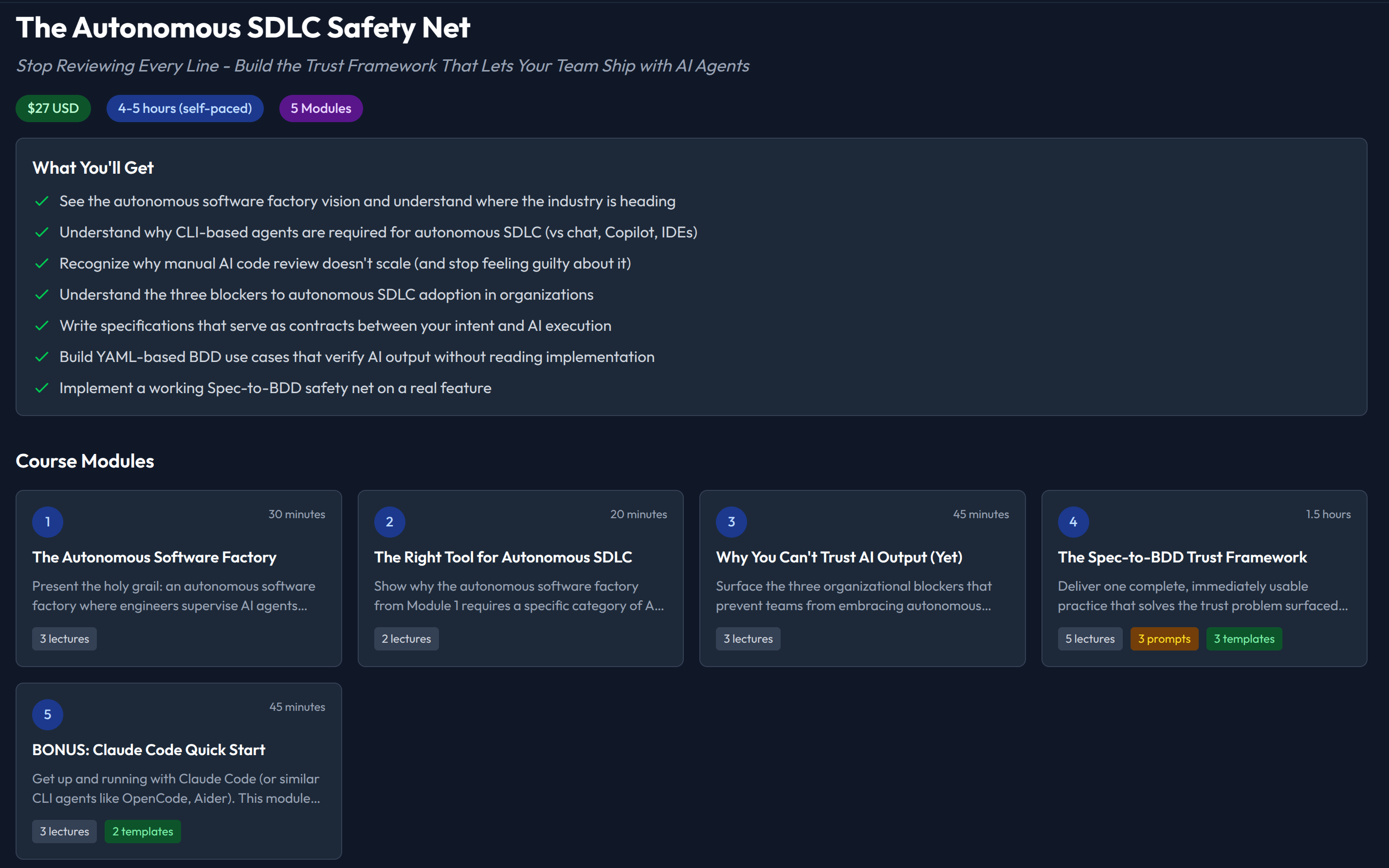
- The Spec & BDD Trust Framework (the practice)
- 3 Claude Code skills (use tomorrow)
- Templates for specs and BDD scenarios
- Hands-on exercises on a precreated project
- The Autonomous Workflow Runner (working code)
- Community access
- Group Consulting Calls
- Early sneak peek into Blueprint Platform & Software Factory Engine (and a voice in shaping the roadmap)
- Early access to everything I build next
The Value Stack
(a.k.a. Marketing BS)
🔥 Module 1: The Autonomous Software Factory Vision │ $47 (BS)
🔥 Module 2: The Right Tool for Autonomous SDLC | $37 (BS)
🔥 Module 3: Why You Can't Trust AI Output (Yet) │ $27 (BS)
🔥 Module 4: The Spec-to-BDD Trust Framework │ $197 (BS)
🔥 3 Claude Code Skills │ $97 (BS)
🔥 Templates (Spec, BDD, Verification Checklist) │ $81 (BS)
🔥 Sample Project + 3 Hands-On Exercises │ $94 (BS)
🔥 BONUS: Autonomous Workflow Runner │ $147 (BS)
🔥 BONUS: Claude Code Quick Start │ $37 (BS)
🔥 BONUS: Engineering Leaders Adoption Guide │ $47 (BS)
TOTAL BS VALUE │ $811
YOUR ACTUAL PRICE │ $27 $7
The honest truth: I made up these numbers like everyone else does. The real value is my personal engagement to help you embrace all the required tooling.
That's why there is the 30 days money back guarantee. If you don't like my approach, it's ok.

What's Inside:
Why teach it? → Helps steer AI agents to produce output aligned with my vision
Why steer AI? → So they produce artifacts that match my organization's standards
Why match standards? → Otherwise I spend time reworking AI output to fit our standards
Why is rework a problem? → It slows down iteration
Why does that matter? → Competitive advantage
Root problem: Without specs, AI produces output that doesn't match your standards. You waste time on rework.
Solution: Specs constrain AI upfront so output matches your vision from the start.
Why build it? → Verify code matches behavioral expectations without diving into technical code
Why verify without reading? → Quickly verify implementation aligns with feature expectations — fast
Why without reading? → AI generates code faster than I can read it
Why is that a problem? → Can't embrace full AI power if I manually review every line
Why need full AI power? → To iterate fast and gain competitive advantage
Root problem: Human comprehension is the bottleneck. AI generates faster than humans can read.
Solution: Verify behavior, not code. BDD tests let you check outcomes without reading implementation.
Reason 1: Provide Your Business Context to Agents
Why build it? → AI agents need constant, structured access to business/product/system context
Why structured access? → Otherwise they produce generic output that doesn't fit my domain and architecture
Why is that a problem? → I have to spend time adapting it to my context
Why is adapting a problem? → It slows down my iteration speed
Why does that matter? → Competitive advantage
Root problem: Without structured context, AI produces generic output. You waste time adapting instead of shipping.
Solution: Give AI structured access to your business context so output fits from the start.
Reason 2: Provide Your Business Context to Agents
Why visualize AI artifacts? → Easier and faster comprehension of their artifacts
Why easier comprehension? → AI produces more artifacts than I can manually review
Why is that a problem? → I become the bottleneck for embracing full AI capabilities
Why embrace full AI? → Iterate fast, gain competitive advantage
Root problem: Human comprehension is the bottleneck. AI outputs faster than you can process.
Solution: Visualization tools to quickly grasp AI output without reading everything line by line.
Why teach it? → To enable fast and safe iteration
Why is TBD specifically needed for AI? → Autonomous AI workflows need to ship continuously — not wait for branch merges and manual gates
Why ship continuously? → AI produces changes faster than traditional branch-based workflows can handle
Why is that a problem? → Long-lived branches, manual reviews, big releases become bottlenecks that kill AI's speed advantage
Why does that matter? → TBD is the only workflow that can keep up with AI velocity
**Root problem:** Traditional branching strategies can't handle AI's output speed. You need continuous flow.
**Solution:** TBD + automated testing + feature flags + observability = ship AI changes continuously and safely.